
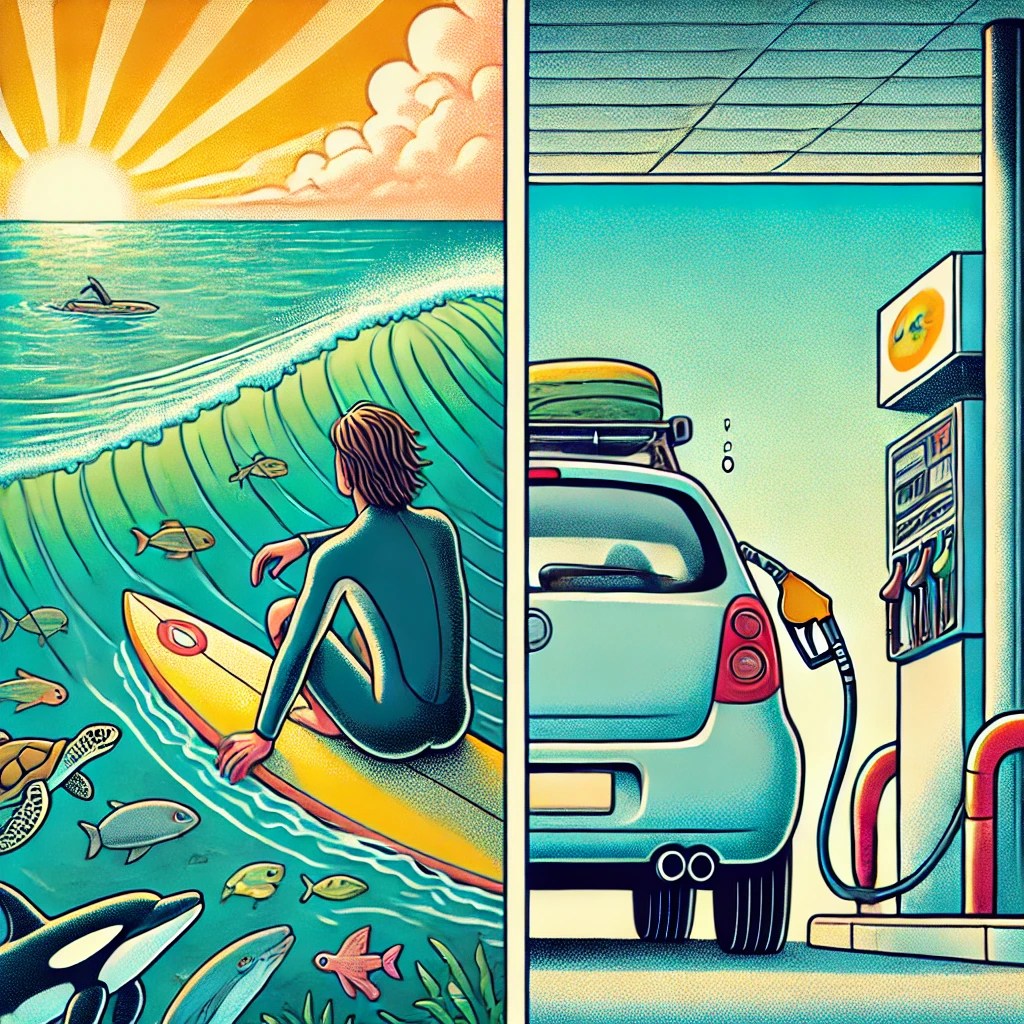
Sitting in the lineup, waiting for the next set to roll through, I am no longer an engineer. I am not a wage earner, a consumer, or a commuter. I am just a speck in the vastness of the ocean, moving with its pulse, weightless in saltwater. In that moment, my priorities are clear: I will do whatever it takes to protect this space, the ocean I float in, the waves that give me joy, the life beneath the surface that exists despite humanity’s relentless expansion.
And yet, the paradox is impossible to ignore. The board beneath me? A hardened petrochemical cocktail. My wetsuit? A neoprene disaster derived from oil and gas. The car that got me here? A four-hour, gas guzzling pilgrimage for waves, adding CO2‚ to the very atmosphere that fuels rising ocean temperatures and shifting swell patterns. Back on land, I’ll dry off, refuel my car, and re-enter the world of work emails that demand answers, bills that demand payment, a life that demands resources.
Purpose vs. Profit: A False Choice?
This contradiction mirrors the broader conversation around sustainability today. The corporate world is going through its own existential reckoning. ESG (Environmental, Social, and Governance) initiatives are held up as the gold standard of corporate responsibility, but increasingly are under attack. Some call it the death of ESG, pointing to budget cuts, regulatory pullbacks, and companies stepping back from big climate commitments. Others argue that this is simply the next evolution where sustainability must prove its worth not just in moral arguments but in cold, hard business metrics.
Is this hypocrisy? Maybe. But perhaps it’s just a reflection of how we navigate imperfect systems while trying to create better ones.
The New Reality: Sustainability Without Illusions
The idealistic wave of ESG where companies could get by on goodwill and vague commitments is fading. What remains is what works. If sustainability doesn’t generate value, it won’t last. In fact sustainability won’t be sustainable! And maybe that’s a good thing. The most impactful sustainability efforts won’t be the ones made for marketing campaigns or shareholder appeasement. They will be the ones tied to:
✅ Efficiency that saves money (less waste, lower fuel consumption, smarter logistics)
✅ Risk reduction (climate resilience, supply chain adaptability)
✅ Customer demand (low-carbon solutions as competitive advantages)
✅ Regulatory inevitability (preparing for shifts rather than reacting)
Just as a surfer learns to work with the ocean rather than against it, the future of sustainability will belong to those who integrate it into the natural flow of business. The old ESG built on branding and lofty pledges is being stripped away, much like an incoming tide erases footprints in the sand. What remains is sustainability that is embedded, necessary, and, ultimately, profitable.
Riding the Wave of Change
Sitting on my board, watching the horizon, I wrestle with this paradox. Can I love the ocean while acknowledging my role in its destruction? Can companies embrace sustainability without pretending to be perfect? Can profit and purpose exist together?
The answer isn’t simple, but it is honest: we are all part of the problem, and we are all part of the solution. The goal isn’t purity, it’s progress. Just as no surfer can control the ocean, no company or individual can escape the reality of modern life. But we can learn to navigate it better, make smarter choices, and find ways to align what we value with how we operate.
Because at the end of the day, whether it’s a surfer chasing waves or a business chasing returns, survival comes down to one thing: adaptation. And those who fail to evolve whether in the water or in the boardroom will find themselves left behind.
 Saltwater Stoke
Leave a comment