
Imagine halving the UK’s carbon emissions in a decade. Not through some miraculous technological breakthrough or wishful thinking, but with the tools we already have. If every vehicle in the UK were electric, manufactured and powered by renewable energy, we could save nearly two gigatonnes of CO₂ in ten years. Two gigatonnes. That’s not a precise figure, it’s an illustrative one. The point isn’t the exact number; it’s the sheer scale of what’s possible. And here’s the catch: achieving this would mean building around 53,000 wind turbines. It sounds enormous, even impossible, but before the cries of outrage begin; “It’ll ruin the countryside! Where will we put them all?”, let’s pause to consider what this really means.
I recently came across a post by an author who estimated that the UK’s current fleet of electric vehicles, about 2.1 million, could be powered by just 50 wind turbines. It’s a striking calculation, one that reveals just how efficient wind energy can be. But it also raised a question for me: what if we scaled up? What if every car, van, and truck on the road were electric? And not just that, what if we considered the entire lifecycle of those vehicles, from manufacturing to operation, and compared it to the fossil fuel extraction, refinement, and vehicle production we rely on today?
So, I scaled the idea. Roughly, yes, but in a way that helps us grasp the enormity of the challenge, and the opportunity. The result? Around 53,000 turbines would be needed to power every vehicle in the UK. It’s a number that forces us to confront the realities of transitioning to renewables, but it’s also a number that puts the challenge in perspective. Because 53,000 turbines are not a technical impossibility; they’re a question of will.
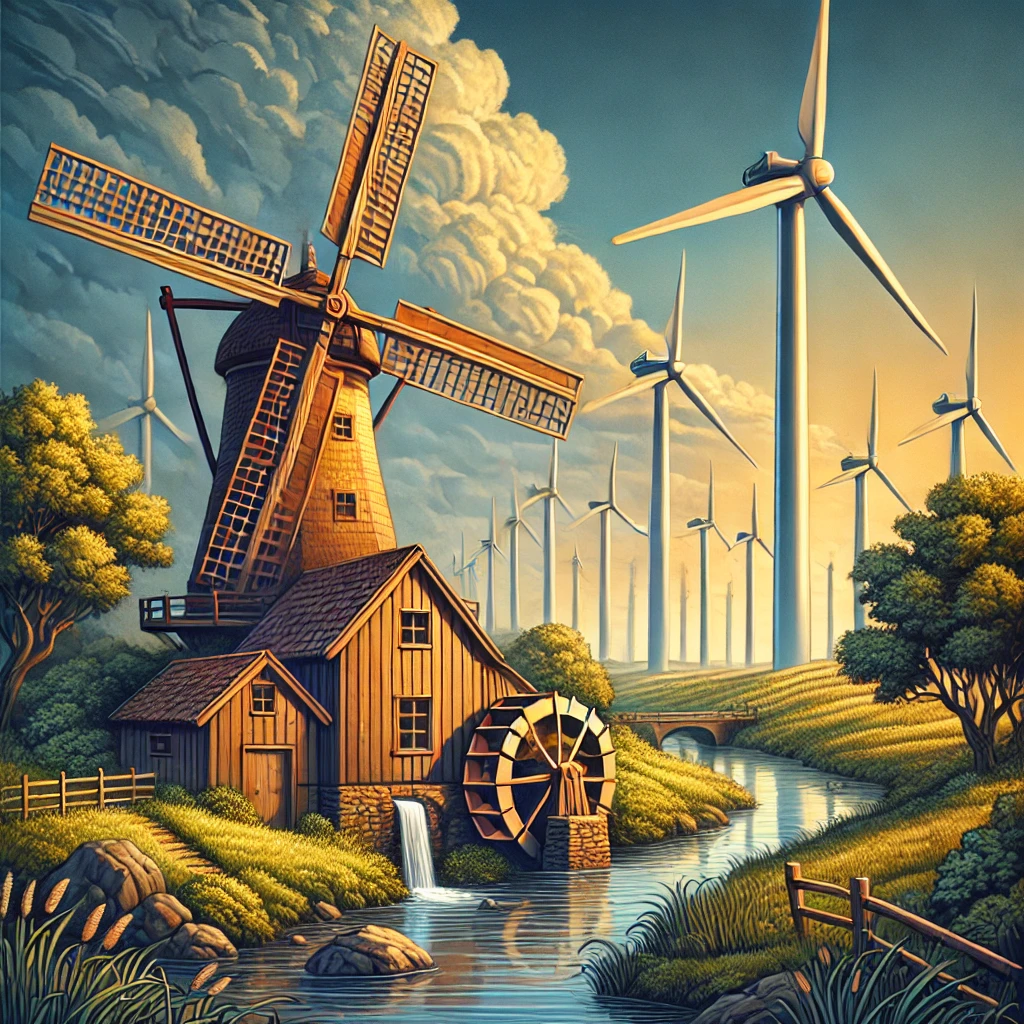
Long before coal smothered the skies and oil choked the oceans, the UK relied on nature for its power. Windmills and waterwheels dotted the landscape, harnessing the forces of wind and water to grind grain, weave textiles, and drive industry. At their height, there were 10,000 windmills and 30,000 waterwheels scattered across the country. These weren’t “blots on the landscape.” They were progress incarnate, spinning their way into the very fabric of British life.
Today, we treat these structures with reverence, pouring millions into preserving them as heritage. Yet, when it comes to modern wind turbines, sleek, elegant machines capable of producing more energy than thousands of their forebears combined, the outcry is deafening. “They’ll destroy the view!” they say. But what view, exactly, are we protecting? A world battered by rising seas, polluted skies, and unrelenting heatwaves? If 40,000 wind and water-powered machines could coexist with the communities of a smaller, less industrialized Britain, surely today’s far more efficient technology can find its place.
The challenge isn’t technological. It’s psychological. People resist change. They always have. In 1952, London’s Great Smog killed over 12,000 people, choking the city in a lethal haze of coal smoke and mist. For years, Londoners had accepted the fog as a grim feature of life in the capital. It was only after the sheer scale of death became undeniable that the government acted. The Clean Air Act of 1956 wasn’t popular. People didn’t want to give up their coal fires or pay for cleaner fuels. But the law didn’t ask for their opinion, it demanded compliance. And it worked. Within a decade, the killer fogs were gone, and Londoners were breathing again.
This is what bold regulation does. It confronts inertia head-on and forces the kind of collective action that individuals alone cannot muster. It shows us what’s possible when governments take responsibility and enforce change. The Clean Air Act didn’t just save lives; it demonstrated that adaptation is within our grasp, if we’re willing to embrace it.
And now we face a far greater challenge. The climate crisis is no longer looming, it’s here. Rising seas, burning forests, collapsing ecosystems. The evidence is as clear as that choking London fog once was. We know the solution. It’s not a mystery. Wind, solar, and tidal power can transform our energy systems, just as they powered our pre-industrial industries. The only thing standing in our way is us.
The transition to renewable energy isn’t a burden; it’s an opportunity. Clean energy already powers industries, creates jobs, and offers energy stability in a world of volatile fossil fuel prices. With scaling and investment, renewables can do even more, without leaving behind the trail of destruction that fossil fuels have carved into the planet.
Yes, the transition will be disruptive. It will demand adaptation. But that’s the price of progress, and it’s a price we’ve paid before. Our ancestors built their lives around windmills and waterwheels, embracing the natural forces that surrounded them. When coal-fired smog darkened London, we rose to the challenge and cleared the skies. Now, the stakes are higher, but so are our capabilities.
The question is not whether we can adapt, it’s whether we choose to. The answer will define our future.
 Saltwater Stoke
Leave a comment