
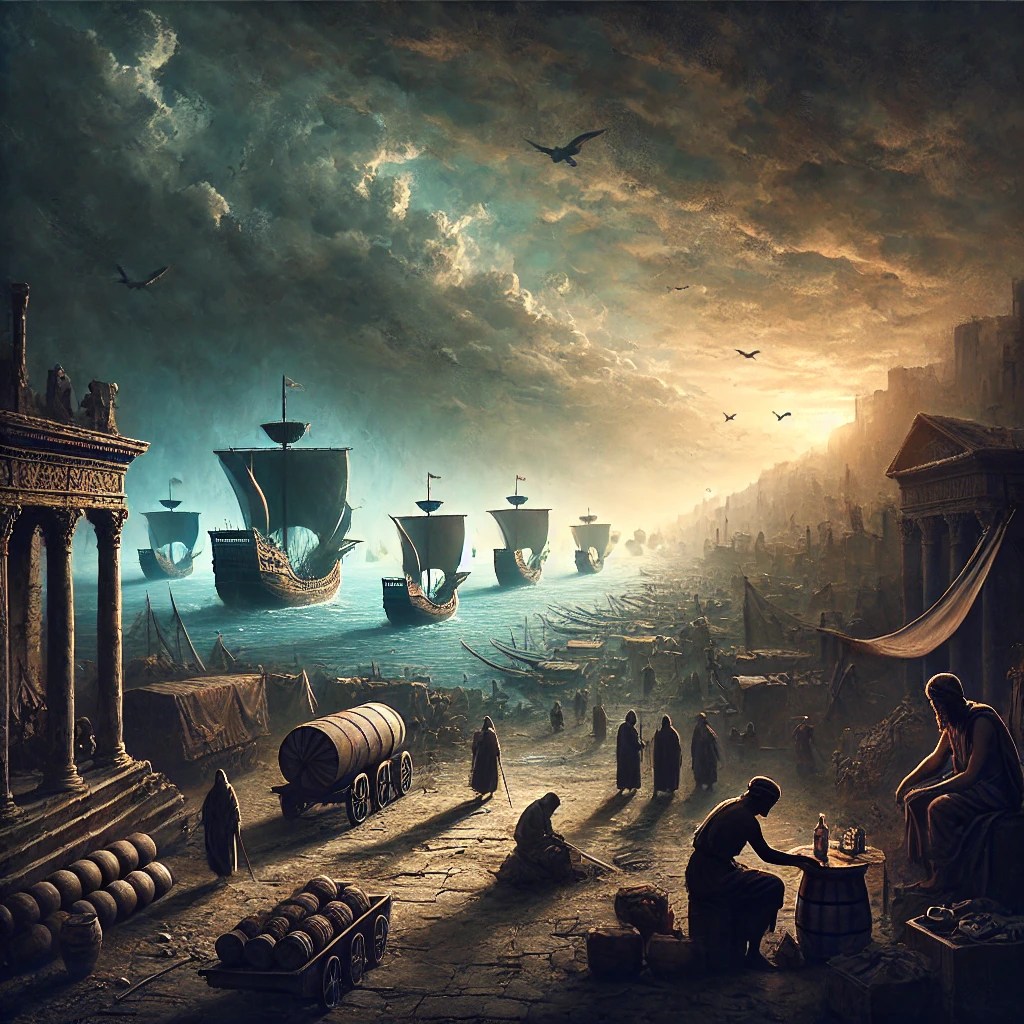
History, at its best, serves as a mirror, reflecting not only the choices of the past but also the consequences of ignoring inconvenient truths. In a recent Daily Mail article, science and technology reporter Nikki Main spoke to Lev Cosijns from the University of Oxford and Haggai Olshanetsky from the University of Warsaw about the research they and their team have conducted that sheds new light on the decline of the Roman Empire and disrupts long held beliefs about its causes. This work offers lessons not only about history but also about how we engage with the climate crisis today.
Through meticulous analysis of Roman maritime activity, the researchers found a dramatic drop in the number of ships berthed at Mediterranean ports during the 6th century. Their study revealed that this decline was driven not by climate change or plague, as traditionally assumed, but by the tightening grip of the Persian Empire on critical eastern trade routes. By severing the flow of goods to Rome, these geopolitical shifts weakened the empire’s economy, undermining its resilience and hastening its collapse.
The conclusions drawn by Dr. Olshanetsky and Dr. Cosijns challenge both historical and contemporary narratives. As they point out, “We think that looking for climate change and plague as the cause for every significant change in history is problematic. This approach can especially harm the current climate change debate when claiming that past climate change caused catastrophic disruptions in society, in cases when there were none or limited effects.”
This is a stark warning to those who minimize today’s climate crisis by invoking historical climate events. Climate denialists often argue that societal disruptions attributed to environmental changes are nothing new, implying that the current crisis is part of a natural cycle. But this research counters such claims, showing that societal collapse is rarely the result of environmental factors alone. Instead, it underscores the importance of human agency whether in disrupting trade routes, overexploiting resources, or failing to respond to emerging threats.
The story of Rome’s fall is a reminder that history is shaped as much by human choices as by environmental conditions. Just as geopolitical actions hastened the Roman Empire’s decline, today’s climate crisis is not an inevitability, it is a direct consequence of human activity, from carbon emissions to deforestation. The choices we make now will determine whether we suffer a similar fate or find a path to resilience.
By shining a light on this chapter of history, Dr. Olshanetsky and Dr. Cosijns have given us more than an academic insight. They’ve armed us with a powerful argument against the dangerous myth that humanity is powerless in the face of environmental change. Their work shows that while nature sets the stage, it is human decisions that determine the outcome.
The lesson for the present is clear: denial is not an option. The evidence is there, both in the climate data and in the ruins of past civilizations. We can choose to act, drawing on the lessons of history to forge a sustainable future, or we can follow the Romans into decline. The choice is ours.


 Saltwater Stoke
Leave a comment